
ETP Plant For...
- Home
- /
- ETP Plant For Hospitals
Quick Services
For More Information
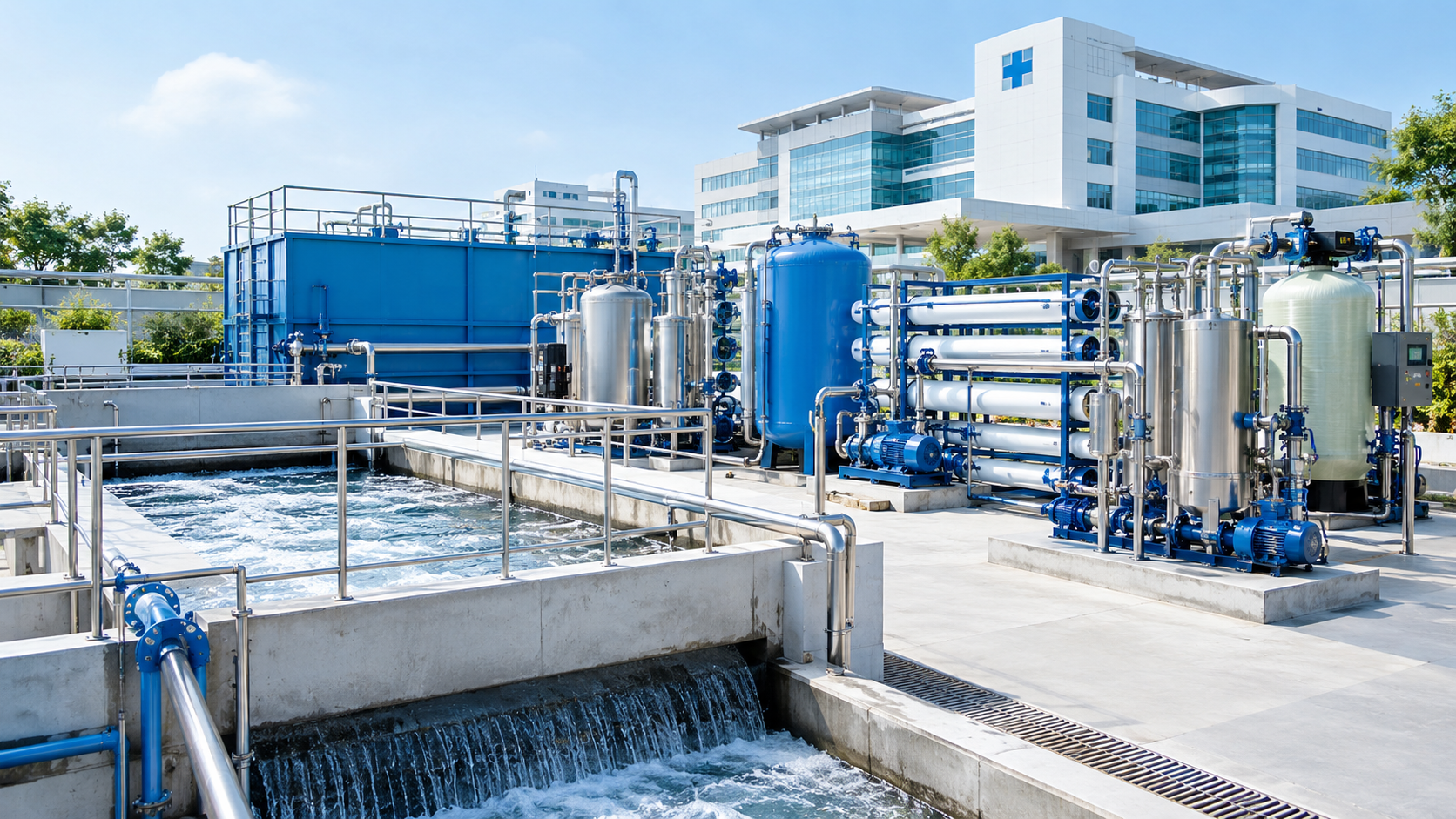
ETP Plant for Hospitals
Hospitals generate wastewater from laboratories, operation theatres, patient wards, laundry areas, kitchens, diagnostic departments, and other healthcare activities. Unlike ordinary domestic sewage, hospital wastewater can contain chemicals, disinfectants, pharmaceutical residues, suspended solids, organic matter, and other contaminants that require appropriate treatment before discharge or reuse.
A properly designed ETP Plant for Hospitals helps healthcare facilities treat their wastewater efficiently and manage it according to applicable environmental requirements. The treatment system is selected according to the hospital's wastewater characteristics, daily flow, available space, treatment objectives, and proposed disposal or reuse method.
Neel Guard Aqua Systems provides customized industrial and commercial wastewater treatment solutions for hospitals, healthcare facilities, laboratories, and other institutions. Our approach focuses on selecting the right treatment process and plant configuration rather than using a standard system for every site.
Call: +91 9899484477
Why Hospitals Need an ETP Plant
Hospital wastewater requires careful treatment because different departments can contribute different types of pollutants to the overall wastewater stream.
Wastewater may originate from:
- Laboratories and diagnostic areas
- Operation theatres and treatment rooms
- Laundry and housekeeping activities
- Kitchens and food service areas
- Patient rooms and wards
- Medical and healthcare processes
- Cleaning and disinfection activities
- Other hospital utility operations
The wastewater characteristics can vary significantly depending on the size and activities of the healthcare facility. An appropriately designed ETP for hospitals helps reduce pollutants and improve the quality of treated water before its final disposal or further use.
The treatment requirement should therefore be determined after understanding the wastewater source, flow rate, pollutant load, treatment standards, and site-specific conditions.
What Is an ETP Plant for Hospitals?
An Effluent Treatment Plant (ETP) for hospitals is a wastewater treatment system designed to treat contaminated water generated from hospital and healthcare-related activities.
The plant uses a combination of physical, chemical, and biological treatment processes to reduce contaminants from wastewater. Depending on the wastewater characteristics and required treated-water quality, the treatment system may include processes such as screening, equalization, biological treatment, clarification, filtration, disinfection, and sludge management.
The exact process configuration is not the same for every hospital. A small healthcare facility may require a compact treatment arrangement, while a large hospital with laboratories, laundry facilities, kitchens, and multiple departments may require a more comprehensive system.
How Does an ETP for Hospitals Work?
A hospital ETP generally uses multiple treatment stages. The final configuration depends on wastewater analysis and the required discharge or reuse standards.
1. Screening
The incoming wastewater first passes through screening arrangements to remove larger floating materials and debris.
This protects downstream equipment and reduces the possibility of blockages in pumps and pipelines.
2. Collection and Equalization
Wastewater is collected in an equalization tank where variations in flow and pollutant concentration can be balanced.
Equalization provides a more consistent flow to subsequent treatment stages and helps the biological or chemical treatment process operate more steadily.
3. Primary Treatment
Primary treatment helps remove settleable solids, suspended particles, oil, grease, and other physical contaminants depending on the selected process.
The objective is to reduce the load entering the subsequent treatment stages.
4. Biological Treatment
Biological treatment uses microorganisms to break down biodegradable organic matter present in wastewater.
Depending on the wastewater characteristics and design requirements, different biological treatment technologies may be considered.
5. Secondary Clarification
After biological treatment, the treated wastewater may enter a clarification stage where biological solids are separated from the liquid.
This helps reduce suspended solids before further treatment.
6. Tertiary Treatment
Where higher treated-water quality is required, tertiary treatment can be incorporated.
Depending on the application, this may involve filtration and other polishing processes designed to improve specific water-quality parameters.
7. Disinfection
Disinfection may be included as part of the final treatment stage where required by the treatment objective and applicable requirements.
The selected disinfection method depends on the plant design and intended use or disposal of the treated water.
8. Sludge Management
Treatment processes generate sludge that must be collected, handled, and disposed of appropriately.
A complete hospital ETP design therefore considers sludge management along with liquid wastewater treatment.
Key Treatment Processes Used in Hospital ETP Plants
The treatment technology should be selected according to wastewater characteristics rather than simply choosing a plant based on capacity.
Depending on the application, a hospital ETP may incorporate:
- Bar screening
- Oil and grease removal
- Equalization
- pH correction
- Chemical treatment
- Coagulation and flocculation
- Biological treatment
- Secondary clarification
- Pressure sand filtration
- Activated carbon filtration
- Disinfection
- Sludge dewatering
- Treated-water storage
- Additional polishing or advanced treatment where required
The final combination is determined during the design stage after evaluating the wastewater source, flow, pollutant load, available space, and treatment objectives.
ETP Plant Capacity for Hospitals
Hospital ETP capacity is generally determined from the wastewater generation pattern rather than selecting a fixed capacity based only on the number of beds.
Important factors include:
- Number of hospital beds
- Average daily water consumption
- Wastewater generation
- Number of operating departments
- Laboratory activities
- Laundry operations
- Kitchen and food service
- Number of staff and visitors
- Peak wastewater flow
- Existing sewage treatment arrangements
- Required treated-water quality
- Future expansion plans
For example, two hospitals with a similar number of beds may have different wastewater treatment requirements because their laboratories, laundry facilities, water consumption, and operational processes may differ.
The correct ETP capacity should therefore be calculated from actual or estimated wastewater flow and site conditions.
Hospital ETP Plant Design Considerations
A reliable hospital wastewater treatment system requires more than simply installing treatment tanks and equipment.
Wastewater Characterization
Understanding the wastewater composition is an important part of selecting the treatment process. Parameters such as pH, BOD, COD, TSS, oil and grease, and other relevant contaminants can help determine the treatment requirements.
Flow Variation
Hospital wastewater generation may change throughout the day. Equalization and hydraulic design should account for variations in flow.
Space Availability
Hospitals often have limited space for utility installations. Compact or modular treatment configurations may be considered where appropriate.
Treated-Water Objective
The required treatment level depends on whether treated water is intended for discharge, reuse, or further treatment.
Ease of Operation
The plant should be designed with practical operation and maintenance requirements in mind. Access to pumps, blowers, filters, tanks, electrical panels, and other equipment should be considered during layout planning.
Future Expansion
If the hospital plans to increase its capacity or add departments, the treatment system should be evaluated for possible future wastewater increases.
Benefits of Installing an ETP Plant in Hospitals
A properly designed hospital ETP can provide several operational and environmental benefits.
Better Wastewater Management
The treatment system provides a controlled method for managing wastewater generated by different hospital activities.
Reduction of Pollutant Load
Appropriate treatment processes can reduce organic matter, suspended solids, and other targeted contaminants from wastewater.
Potential Water Reuse
Depending on treated-water quality and applicable requirements, treated wastewater may be suitable for selected non-potable applications after appropriate treatment.
Better Environmental Management
Effective wastewater treatment helps hospitals manage their environmental responsibilities and reduce the impact associated with untreated or inadequately treated effluent.
Controlled Sludge Handling
A properly planned treatment system also considers the collection and management of sludge generated during wastewater treatment.
Support for Regulatory Compliance
Treatment systems can be designed around applicable discharge and reuse requirements, helping facilities work toward their environmental compliance obligations.
How Much Does a Hospital ETP Plant Cost?
The cost of an ETP Plant for hospitals cannot be accurately determined from capacity alone.
The overall project cost can depend on:
- ETP capacity
- Wastewater characteristics
- Selected treatment technology
- Number and type of treatment stages
- Tank construction
- Equipment specifications
- Automation requirements
- Filtration requirements
- Disinfection system
- Sludge handling system
- Installation conditions
- Civil and electrical work
- Site accessibility
- Treated-water requirements
A laboratory or hospital with specialized wastewater characteristics may require a different treatment configuration from a facility generating mainly domestic-type wastewater.
For this reason, a proper requirement assessment is recommended before quoting the final plant cost.
Call Neel Guard Aqua Systems: +91 9899484477
Why Choose Neel Guard Aqua Systems?
Neel Guard Aqua Systems provides water and wastewater treatment solutions for commercial and industrial applications.
With 15+ years of experience, 1,000+ installations, and 400+ clients, our focus is on developing treatment solutions according to the practical requirements of each project.
Our wastewater treatment solutions can be customized around factors such as:
- Required treatment capacity
- Wastewater characteristics
- Available installation space
- Treatment objectives
- Operational requirements
- Maintenance considerations
- Future capacity requirements
Rather than recommending the same configuration for every facility, the treatment process should be evaluated according to the wastewater generated at the site.
Hospital ETP Installation Process
A typical project can involve the following stages:
1. Requirement Discussion
Our team understands the hospital's wastewater sources, approximate flow, site conditions, and treatment objectives.
2. Wastewater Assessment
Available wastewater test data or relevant water-quality parameters are reviewed to understand the treatment requirement.
3. Treatment Process Selection
The appropriate combination of physical, chemical, biological, and tertiary treatment stages is considered.
4. Plant Design
The treatment system is planned according to capacity, process requirements, available space, equipment, and operational considerations.
5. Manufacturing and Equipment Selection
The required tanks, pumps, blowers, filtration systems, electrical components, and other equipment are selected according to the approved design.
6. Installation and Commissioning
The plant is installed at the site and commissioned according to the project requirements.
7. Operation and Maintenance Support
Regular operation and maintenance are important for maintaining consistent treatment performance. The plant should be operated according to its design parameters and maintenance schedule.
Applications of Hospital ETP Systems
Hospital wastewater treatment systems can be considered for:
- Multi-specialty hospitals
- Private hospitals
- Government hospitals
- Medical colleges
- Healthcare facilities
- Diagnostic centres
- Laboratories
- Specialty healthcare centres
- Large clinics
- Institutional healthcare facilities
The treatment configuration may vary depending on the wastewater sources and activities carried out at each facility.
Frequently Asked Questions
What is an ETP Plant for hospitals?
An ETP Plant for hospitals is a wastewater treatment system designed to treat effluent generated from hospital and healthcare-related activities. It can combine physical, chemical, biological, and tertiary treatment processes depending on wastewater characteristics and treatment objectives.
Is ETP required in every hospital?
The requirement depends on the hospital's wastewater sources, applicable environmental requirements, local regulations, and the treatment/disposal arrangement at the site. A wastewater assessment can help determine the appropriate treatment system.
What capacity ETP is required for a hospital?
ETP capacity depends on wastewater generation rather than only the number of hospital beds. Water consumption, wastewater flow, departments, laboratories, laundry, kitchens, and future expansion should be considered while determining capacity.
How much does an ETP Plant for a hospital cost?
The cost depends on capacity, wastewater characteristics, treatment technology, equipment, civil work, automation, installation conditions, and required treated-water quality. A site-specific assessment is recommended for an accurate estimate.
Can treated hospital wastewater be reused?
Treated wastewater may be considered for selected non-potable applications when the treated-water quality meets the requirements for the intended use and applicable regulations. Additional treatment may be necessary for specific reuse applications.