ETP Plant for...
- Home
- /
- ETP Plant for Hotels – Complete Hotel Wastewater Treatment Solutions
Quick Services
For More Information
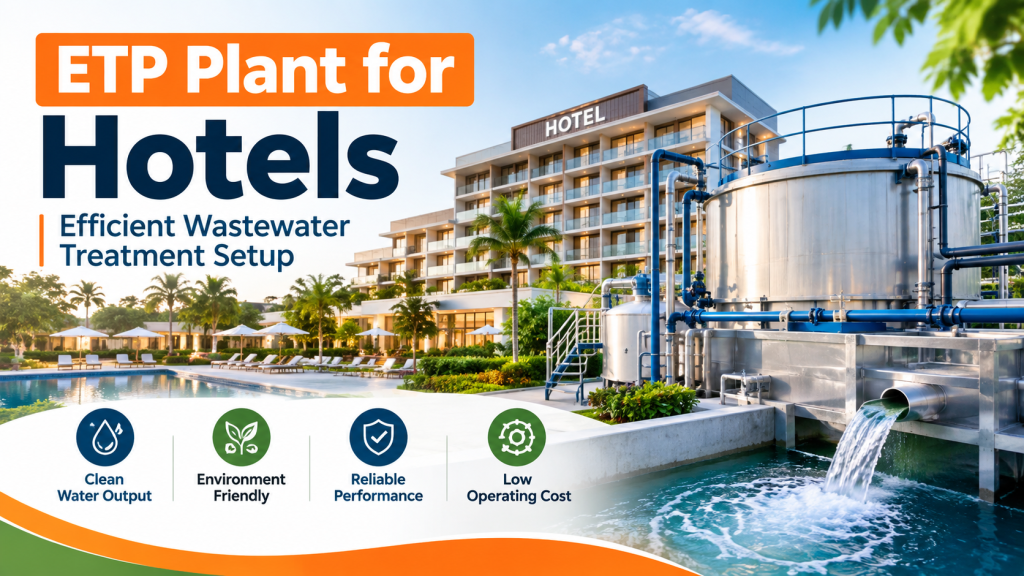
ETP Plant for Hotels – Complete Hotel Wastewater Treatment Solutions
Hotels use water across almost every part of their daily operations. Guest rooms, bathrooms, kitchens, restaurants, laundries, housekeeping, staff facilities, banquet halls and other hotel services all contribute to wastewater generation. Unlike a simple domestic wastewater stream, wastewater from a hotel can vary considerably depending on occupancy, food-service activities, laundry operations and peak usage periods.
An ETP Plant for Hotels is designed to manage and treat wastewater according to the actual characteristics of the effluent generated at the property. The treatment system may combine screening, equalization, oil and grease removal, physical or chemical treatment, biological treatment, filtration and disinfection, depending on the wastewater quality and the intended use of treated water.
For a hotel, choosing an ETP should not be based only on the size of the property or a standard plant capacity. A properly planned Hotel ETP Plant considers wastewater flow, peak load, wastewater characteristics, available installation space, operating conditions, future requirements and the quality expected after treatment.
Why Hotels Need an ETP Plant
A hotel can generate wastewater from several different sources throughout the day. Guest bathrooms contribute sewage and greywater, while kitchens and restaurants may introduce food particles, oil and grease. Laundry operations can add detergents, suspended solids and other cleaning-related contaminants.
The quantity of wastewater can also change significantly. A hotel may have relatively low wastewater generation during off-peak periods but experience much higher flows during weekends, holidays, conferences, weddings or other events. This variation needs to be considered while planning the treatment capacity.
A properly designed ETP for Hotels provides a controlled treatment arrangement instead of allowing different wastewater streams to be managed without a defined process. It can also support responsible water management by creating opportunities for suitable treated-water reuse where the required quality and applicable conditions allow it.
Sources of Hotel Wastewater
Understanding where wastewater comes from is an important part of ETP planning. A typical hotel may generate wastewater from:
- Guest rooms and bathrooms
- Kitchens and restaurants
- Laundry and housekeeping
- Banquet and event facilities
- Staff rooms and common facilities
- Cleaning and maintenance activities
- Other commercial operations within the property
Not every wastewater stream necessarily has the same characteristics. For example, kitchen wastewater can have a higher oil and grease load, while laundry wastewater may contain detergents and suspended matter. This is why wastewater characterization should be considered before finalizing the treatment process.
How Does a Hotel ETP Plant Work?
The treatment process depends on the wastewater entering the plant and the required treated-water quality. There is no single configuration that is technically suitable for every hotel.
A typical Hotel Wastewater Treatment Plant may include the following stages:
Screening and Preliminary Treatment
The first stage removes larger floating and suspended materials that could interfere with pumps, pipes or downstream treatment equipment. Screening provides basic protection for the treatment system and helps improve the reliability of subsequent stages.
Equalization and Flow Balancing
Because hotel wastewater generation can fluctuate throughout the day, an equalization tank can help balance variations in flow and pollutant loading. This creates a more stable wastewater feed for the treatment stages that follow.
Oil and Grease Removal
Kitchen and restaurant wastewater may contain fats, oils and grease. Where required, an appropriate separation stage can be incorporated to reduce these materials before biological or other downstream treatment.
Biological Treatment
Biological treatment is used where biodegradable organic matter is a significant component of the wastewater. Depending on the project, technologies such as MBBR or other suitable biological processes may be considered.
The selection depends on factors such as organic loading, required treatment performance, available area, operating conditions and the characteristics established through wastewater analysis.
Filtration and Disinfection
Additional filtration or polishing may be required after biological treatment. Disinfection can also be incorporated when the treated-water application requires microbial control.
The final treatment arrangement should therefore be developed according to the actual project rather than selecting equipment solely from a standard catalogue.
ETP Plant Design for Hotels
The design of an ETP Plant for Hotels starts with understanding how much wastewater the property generates and what is present in that wastewater.
Hotel ETP design should consider average flow as well as peak flow. Occupancy levels, restaurant capacity, laundry operations, banquet facilities and seasonal demand can all affect wastewater generation.
Other important design considerations include:
- Wastewater characteristics and laboratory analysis
- Average and peak wastewater flow
- Hotel occupancy and future expansion
- Kitchen and restaurant wastewater
- Laundry wastewater
- Available plant area
- Equipment accessibility
- Sludge generation and handling
- Required treated-water quality
- Potential water reuse applications
- Power and operational requirements
This approach helps avoid both under-sizing and unnecessary over-sizing of the treatment system.
ETP Plant for Hotels and Resorts
Hotels and resorts often have different wastewater management requirements. Resorts may have larger landscaped areas, swimming-pool facilities, restaurants, event spaces and seasonal occupancy patterns, while city hotels may have limited utility space.
For properties with restricted space, a compact ETP plant for hotels and resorts can be considered where technically appropriate. Compact systems can provide a smaller footprint while integrating the required treatment stages into a more space-efficient arrangement.
However, compact does not simply mean smaller equipment. The plant still needs adequate hydraulic capacity, treatment volume, maintenance access and suitable process design for the expected wastewater load.
Treated Water Reuse in Hotels
One of the important reasons hotels evaluate wastewater treatment is the possibility of reducing freshwater demand through appropriate reuse.
Depending on the treatment quality achieved and the intended application, treated wastewater may potentially be considered for non-potable uses such as:
- Landscape and garden irrigation
- Toilet flushing
- Certain cleaning applications
- Other suitable non-potable purposes
The reuse objective should ideally be considered during the initial ETP plant design for hotels. This allows the treatment process to be selected according to the quality required for the intended application instead of treating wastewater without a defined end use.
How to Choose ETP Plant Manufacturers for Hotels
Selecting the right ETP Plant Manufacturer for Hotels is an important project decision. Hotels should look beyond the equipment itself and evaluate whether the manufacturer understands the property's wastewater characteristics, operating pattern and space limitations.
A suitable project partner should be able to support the complete process, from wastewater assessment and process selection to design, manufacturing, installation and commissioning.
It is also important to understand what happens after installation. Pumps, blowers, filters, dosing systems, biological treatment units and other components require regular monitoring and maintenance. A manufacturer that can provide appropriate technical support can make long-term plant operation easier.
ETP Installation and Commissioning
An ETP installation involves more than placing tanks and equipment at the hotel site. The equipment layout, interconnecting piping, pumps, blowers, electrical systems, dosing arrangements and control systems need to work together as one treatment system.
After installation, commissioning helps verify that the equipment and treatment stages are operating according to the designed configuration. Operating parameters can then be established for routine plant operation.
For hotels, this is particularly important because wastewater treatment is part of an ongoing facility operation. A poorly planned installation can create accessibility and maintenance difficulties later.
ETP Plant Cost for Hotels
The ETP Plant Cost for Hotels cannot be accurately determined from hotel room count alone. Two hotels with similar room capacities can have very different wastewater generation because of differences in restaurants, laundry facilities, banquet operations, occupancy and water-use patterns.
The final project cost may depend on:
- Required treatment capacity
- Wastewater characteristics
- Selected treatment technology
- Number and type of treatment stages
- Automation and control requirements
- Filtration and disinfection requirements
- Available installation space
- Civil and electrical work
- Piping and installation requirements
- Treated-water reuse objectives
- Operation and maintenance requirements
For this reason, a project-specific assessment is more useful than relying on a generic online ETP price.
Get a Project-Specific ETP Estimate
Planning an ETP for a new hotel or upgrading an existing wastewater treatment system?
Share your hotel wastewater flow, property details and treatment requirements with our team to discuss a suitable ETP configuration and project-specific cost estimate.
Operation and Maintenance of Hotel ETP
Installing an ETP is only the beginning of wastewater management. Regular operation and maintenance are necessary to keep the treatment system working properly.
Routine activities can include checking pumps and blowers, monitoring treatment parameters, maintaining filters, managing sludge, checking chemical dosing systems and inspecting pipelines and other equipment.
Hotels should also maintain operating records and address unusual changes in flow, odour, treatment performance or equipment operation promptly. Regular maintenance can help identify problems before they develop into larger operational issues.
Why Choose Neel Guard Aqua Systems?
Neel Guard Aqua Systems provides customized water and wastewater treatment solutions for commercial and industrial requirements. Established in 2011, the company works on project-specific treatment systems covering design, manufacturing, installation and commissioning.
For an ETP Plant for Hotels, the approach focuses on understanding the wastewater source, flow requirements, site conditions and intended treated-water application before developing the treatment configuration.
The company also provides solutions across ETP, STP, WTP, RO, DM, UF, water softening and water reuse applications, allowing related water-treatment requirements to be considered as part of a broader project where required.
Have a hotel wastewater treatment requirement? Talk to our team to discuss your project and identify the right ETP solution for your property.
Get the Right ETP for Your Hotel
Every hotel has its own wastewater profile, operating pattern and site limitations. Instead of choosing a standard system based only on capacity or price, it is important to evaluate the complete wastewater requirement before selecting an ETP Plant for Hotels.
Neel Guard Aqua Systems can discuss your wastewater requirements and help determine a suitable treatment approach for your property.
Need an ETP for your hotel or resort?